

 X (ex Twitter)
 Facebook
 Linkedin
Sérénade d’hiver
Musics for Christmas time
16 singers
75 minutes
 17:00
17:00
A propos du programme Sérénade d'hiver
The chamber choir Les Éléments invites you on a musical journey combining songs and poems celebrating winter with sacred polyphonic works for the season.
The programme evokes the Nativity, but also the cold and snow-covered landscapes. We shiver, then warm ourselves by the fire; we fall in love, raise a glass and sing… Come and enjoy this winter’s evening, as Joël Suhubiette and the Toulouse-based choir perform French music from the Middle Ages to the present day.
Note d’intention
"Sérénade d’hiver immerses us in French sacred and secular music selected for the Christmas season. Les Éléments take us on a journey from the Middle Ages to the present day, through works from the repertoire and traditional songs, performed a cappella and specially arranged for the sixteen singers of the chamber choir.
Poulenc, Debussy, Saint-Saëns, Du Caurroy and Busnois are placed alongside Basque, Poitevin and Provençal Christmas songs, whose familiar melodies invite us to share in the festive spirit. Contemporary composers, meanwhile, have been commissioned to offer a fresh perspective on the theme.
Claire-Mélanie Sinnhuber draws on a Basque poem to create a piece full of sensory impressions — movement, warmth, cold… Patrick Burgan turns to poetry in five different languages to explore the theme of the Nativity. Joan Magrané Figuera takes inspiration from a Christmas motet by Tomás Luis de Victoria, offering us a new interpretation."
"Conceived as a winter gathering around the warmth of a fireside, this programme is an ideal opportunity to invite other choirs to join us. Educational projects can therefore be developed with school, amateur and conservatoire choirs, giving them the opportunity to perform alongside the singers of Les Éléments on selected pieces and, if they wish, to present the opening part of the concert."
Programme
Compositeurs
Oeuvres
* Commande du Chœur de chambre Les éléments
** Arrangements Pierre Jeannot
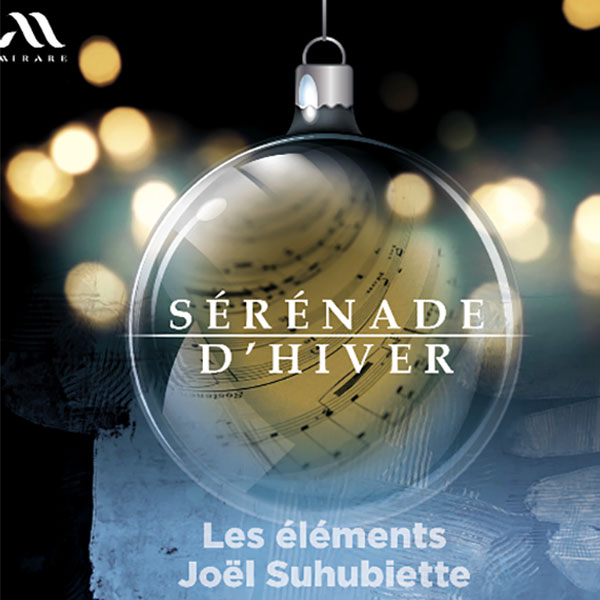
Sérénade d’hiver
Les Éléments - Joël Suhubiette
Les Éléments vous invitent à une veillée d’hiver, un voyage musical du Moyen Âge à aujourd’hui où chansons et poèmes célèbrent l’hiver, ses fêtes et ses froidures, dans l’intimité du chœur a cappella.
Les grands compositeurs du répertoire côtoient de nouvelles compositions, des arrangements de chants traditionnels de Noël des provinces de France spécialement commandés pour ce programme.
A déguster au coin du feu !
Album Preface
For a long time, the dissemination in France of Christmas songs sung in the vernacular consisted simply of setting new texts to well-known secular — and sometimes bawdy — melodies, according to the principle of parody or contrafactum. Thus, the words of Disons Nau à pleine teste (1582), one of the pieces selected for this programme, follow the melody of Il est jour dist l’alouette (1528) by Claudin de Sermisy. Subsequently, and continuing to the present day, the music of the noëls has been collected, composed, adapted, varied — and published — for voices, instruments and organ, as illustrated by the various arrangements by Pierre Jeannot for this programme. A festival of light on the threshold of the winter solstice, the Christmas season is a time when angels announce the “newborn God” through music. Yet this joy is often tempered by a melancholy that, in some cases, borders on anguish.
This underlying unease runs through all the early and/or popular pieces on this recording, such as Or nous dîtes Marie, published by the Ballard publishing house in its collection Chants des Noëls anciens et nouveaux (1703), or Esprits divins, chantons dans la nuit sainte, a contrafactum of Claude Goudimel’s setting of the Huguenot Psalm 137, Estans assis aux rives aquatiques (1568), “rendered into French verse” by Clément Marot. The same mood can be found in Eustache du Caurroy’s Ave Virgo Gloriosa and in Noël Nouvelet, accompanied by drumbeats prescribed by Pierre Jeannot, which sound like the beating of an anxious heart.
The two “twin” pieces by Antoine Busnois and Antoine Brumel remain within the same sound world, heightened in Brumel’s piece by the repeated scansion of the word “noe” (then pronounced and written in various forms such as “Noüel”, “Nau” or “Noe”), which takes on an almost trance-like quality. The same is true of the traditional Basque Christmas song Birjina gaztetto bat zegoen, and of the Provençal La Cambo me fai mau by Nicolas Saboly, one of the most important collectors, authors (in the Occitan language) and composers of noëls, whose publications (1668–1674) were repeatedly reprinted.
This muted anxiety can even be heard in the first three of Francis Poulenc’s Quatre motets pour le temps de Noël (1951–1952), which foreshadow the tone of his opera Dialogues des Carmélites (1953–1956): in “O magnum Mysterium” (No. 1), one might almost hear the maternal, almost rustic tenderness of the Second Prioress. The breathless breaks in the phrases of No. 2, “Quem vidistis pastores dicite”, underscore the questioning nature of the text. In “Videntes stellam” (No. 3), the evocation of the celestial vault, radiant yet uneasy — marked by a few harmonic bites — begins without a bass, as befits a chorus angelorum, and it is not until No. 4, “Hodie Christus natus est”, that the dotted, celebratory rhythms of this shepherds’ procession emerge.
Un soir de neige, to poems by Paul Éluard, was written by Poulenc between 24 and 26 December 1944 at his home in Noizay, in the Touraine region. Here, the “winter gathering around the fire” envisioned by Joël Suhubiette takes on a darker character, conveyed by the work’s rich bittersweet harmony and the bold harmonic progressions so characteristic of Poulenc, as well as by the aura of mystery surrounding this small wartime cantata, painfully turned inwards.
Eight years earlier, Poulenc had produced his first major choral work, the Sept chansons pour chœur a cappella (1936). One might see in the text of “La blanche neige”, which opens the cycle and was written by another of Poulenc’s favourite poets, Guillaume Apollinaire, the poetic fantasy of a Christmas poem: snow, angels, and geese being plucked for dinner.
Patrick Burgan explained his Chants de neige (2020) as follows: “As always when writing a commissioned work, I tried to follow the brief to the letter: snow, winter, cold, the fireside, Christmas, 16 voices, 4 minutes maximum.” As he had done for Nativités (2005), another a cappella work among the many pieces commissioned by Les Éléments, the composer chose texts dating from the 16th to the 20th centuries, in English, German, Spanish, Italian and French, by Robert Southwell, Friedrich Hölderlin, Juan Ramón Jiménez, Giosuè Carducci and Théophile Gautier.
The singing initially becomes expressionistic, mingling with the cries and declamation of a tenor “in a wild and literally Shakespearean manner” (No. 1); No. 2 seems to recreate “the old scent vapourised” (Albert Giraud) of a chorus by Arnold Schoenberg; a monodic line, first entrusted to the female voices and then the male voices, gradually expands into polyphony (No. 3); the blend of rhythmic speech and singing subsides in No. 4; and No. 5 rings out with a vibrant peal of bells, into which spoken passages are woven and the first soprano’s piercing high notes emerge.
In 2007, Les Éléments premiered I had a dream by Zad Moultaka — another contemporary composer particularly important to the ensemble — based on a “stitching together” of Martin Luther King’s famous speech and testimonies from survivors of Hurricane Katrina in 2005. Flamma (2021), inspired by the fire that engulfed Notre-Dame Cathedral in Paris on 15 April 2019, follows a related approach, drawing on Pérotin the Great’s Beata Viscera Mariae Virginis (“Blessed is the womb of the Virgin Mary, which bore the Son of the Eternal Father”) and Victor Hugo’s Notre-Dame de Paris (1832), in which he gives an imaginary yet strikingly realistic description of the cathedral in flames. Hugo’s text serves as a breathless witness, in the manner of a polyphonic Evangelist, while Pérotin’s hymn, sung by the solo countertenor, seems to embody the permanence of the building and its legend throughout the centuries.
The Camille Saint-Saëns composition that gives this programme its title seems indebted as much to the French Renaissance polyphonic chanson as to the German Romantic Lied for vocal ensemble — in both cases, an intimate form of music in which the performers are, in a sense, their own audience. This delightful Sérénade d’hiver (1868), to words by Henri Cazalis (the inspiration behind the famous Danse macabre), is embodied by a quartet of gallants who carry “ladies and poetry” in their hearts.
The programme opens with the little-known first version (1898) of Claude Debussy’s Yver, vous n’estes qu’un villain, which he would revise ten years later for the Trois Chansons de Charles d’Orléans. It then continues with another rarity, the “Chœur des frileuses”, from Léo Delibes’ opera Kassya (after Sacher-Masoch), left unfinished at the composer’s death in 1891 and completed and orchestrated by Jules Massenet in 1893. The music gently evokes the memory of the “Chorus of Street Urchins” from Bizet’s Carmen (1875).
Finally, the programme concludes with one of the best-known Christmas songs in France, Petit papa Noël, whose music was written by Henri Martinet, a hotel pianist and composer of several Marseille operettas. What is less well known is that the version popularised by Tino Rossi, who first sang it in Richard Pottier’s film Destins (1946), is itself a kind of contrafactum of an earlier version.
The original lyrics, written by Émile Audiffred for Ça reviendra (1944), a revue performed at the Odéon in Marseille that was quickly censored, referred to the Franco-German conflict and had the child asking Santa Claus, with his father being held as a prisoner of war: “And so that Mummy will no longer be so sad, bring my Daddy home.” Rewritten for the film, the familiar lyrics are by Raymond Vincy.
To strip away some of the sweetness from this “hit”, Pierre Jeannot has set aside the sentimental text and arranged the song in the style of close harmony, drawing to a shimmering, sensual close in the upper voices. Truly, the aural delicacy in this Christmas cornucopia.
Renaud Machart, July 2022
Les compositeurs
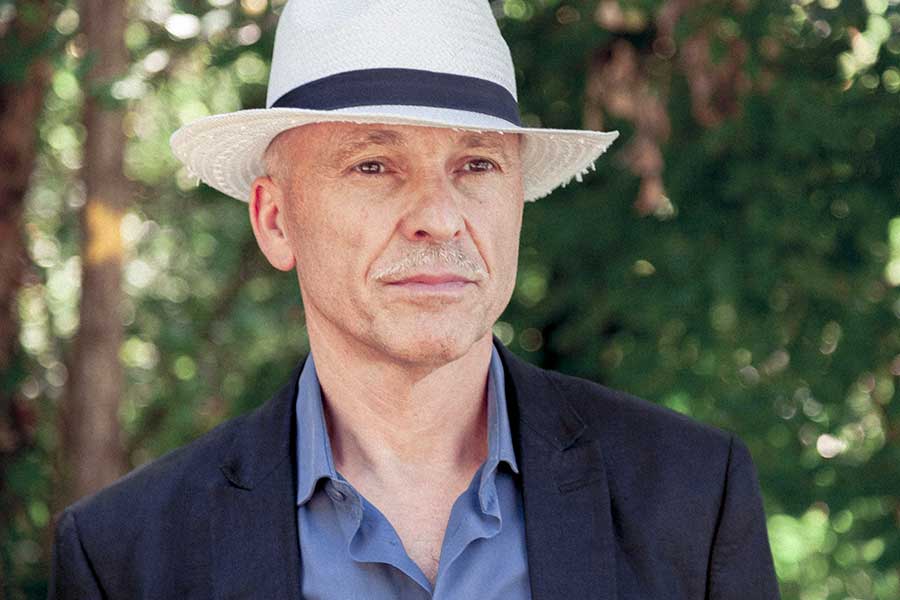
Né en 1960, Patrick Burgan est agrégé de musicologie et titulaire des premiers prix d’orchestration et de composition du CNSM de Paris. Plusieurs fois lauréat de l’Institut, il a été pensionnaire de la Casa de Velasquez à Madrid de 1992 à 1994, et s’est vu attribuer en novembre 1996 le prix de la Fondation “Simone et Cino del Duca” et de l’Académie des Beaux-Arts.
En outre, il est maître de conférences associé à l’université de Toulouse (1998).
Dans son catalogue, qui compte de nombreuses pièces instrumentales allant jusqu’au grand orchestre, on peut noter une prédilection de plus en plus grande pour l’écriture vocale.
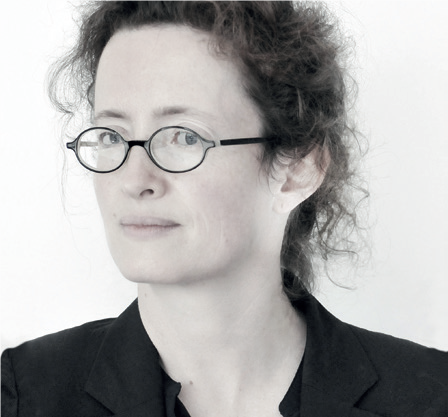
Claire-Mélanie Sinnhuber est née en 1973 à Strasbourg. Après une formation en flûte traversière, elle est diplômée du Conservatoire de Paris et suit le cursus annuel de composition et de nouvelles technologies de l’IRCAM. Parmi ses mentors, on compte Sergio Ortega, Allain Gaussin, Ivan Fedele, Philippe Leroux et Frédéric Durieux. Détentrice de nombreux prix, elle a été lauréate de la Villa Kujoyama en 2008 et pensionnaire de la Villa Médicis de 2010 à 2011. Après avoir beaucoup écrit pour ensemble instrumental, Claire-Mélanie Sinnhuber commence à composer pour la voix en 2013. En résidence au sein des Éléments en 2021, "Temps de neige" est sa première création pour le chœur de chambre.
Dans la presse
La clarté des lignes, la précision de chaque pupitre, une diction soignée et une projection maîtrisée pour une parfaite homogénéité d’ensemble, démontrent l’exigence des Éléments comme leur complicité qu’ils n’hésitent pas à partager avec le public en terminant la soirée en salle plutôt que sur scène »
Flatté par l’acoustique de l’auditorium Saint-Pierre-des-Cuisines, le chœur de chambre toulousain détaille et sculpte le mot avec un soin remarquable.
Homogénéité des voix, clarté de la prosodie, sens des dynamiques et jeux de couleurs… L’expertise du chœur de chambre Les Éléments de Joël Suhubiette, en matière de musique a cappella, n’est plus à démontrer.
Pour les amoureux de musique vocale. Les Éléments, c'est du solide !
Ce délicieux album multilingue, construit avec soin par le chef Joël Suhubiette, et interprété avec le juste mélange de joie, de ferveur mais aussi de mélancolie par son chœur de chambre Les Éléments
Les Quatre motets pour le temps de Noël de Poulenc sont un écrin de recueillement, qui illuminent un disque traversé de douceur.
Un coro que gana en el conjunto, por su sentido del gusto y buen fraseo, y por el eclecticismo de stilos que exhibe: del Renacimiento francés, a encargos de este mismo año. (…) El « ensemble » de Toulouse mostro un excelente potencial para la música contemporánea más vanguardista. Fue un concierto muy original dentro del ciclo. Y muy aplaudido.